

How Interior Designers Communicate With Builders in NSW: A Guide for Homeowners

One of the most common reasons renovations go over budget and over time isn't the builder, and it isn't the designer. It's the gap between them. When a designer and builder aren't communicating clearly — when documentation is incomplete, decisions are delayed, or expectations aren't aligned — the project suffers. This article explains how a collaborative interior designer communicates with builders in NSW, what good designer-builder communication looks like in practice, and why it matters for your renovation timeline, budget, and outcome. If you're planning a renovation and want to understand how the design and construction teams should be working together, this is the article to read first.
TABLE OF CONTENTS
- Why Designer-Builder Communication Is the Hinge Point of Every Renovation
- The Language of Construction: What Builders Actually Need From Designers
- How We Communicate at Each Stage of a Renovation
- The Documentation That Makes Builder Communication Work
- What Happens When Communication Breaks Down
- A Real-World Example: Newcastle New Build
- How to Choose a Designer Who Communicates Well With Builders
- FAQ: Designer-Builder Communication in NSW
- Ready to Work With a Designer Who Speaks Builder?
WHY DESIGNER-BUILDER COMMUNICATION IS THE HINGE POINT OF EVERY RENOVATION
Here's something most homeowners don't know when they start a renovation: the relationship between your designer and your builder is more important than either of them individually.
A brilliant designer with poor builder communication produces beautiful drawings that don't get built correctly. A skilled builder with incomplete documentation makes decisions that should have been made by the designer and those decisions are often expensive to reverse.
The hinge point of every successful renovation is the quality of communication between the design team and the construction team. And in NSW, where renovation projects range from inner-city terrace restorations in Newcastle to rural new builds in the Hunter Valley, that communication needs to be clear, timely, and construction-ready.
At Findlay & Co., we think of our relationship with builders not as a handoff — "here are the drawings, good luck" — but as an ongoing collaboration. We're available throughout the build. We respond to queries quickly. We make decisions when decisions need to be made. And we document everything.
THE LANGUAGE OF CONSTRUCTION: WHAT BUILDERS ACTUALLY NEED FROM DESIGNERS
Builders don't need inspiration. They need information.
When a builder receives a set of design documents, they're looking for specific, actionable information that tells them exactly what to build, where to build it, and what materials to use. Vague or incomplete documentation forces them to make assumptions — and assumptions on a building site are expensive.
What builders need from designers:
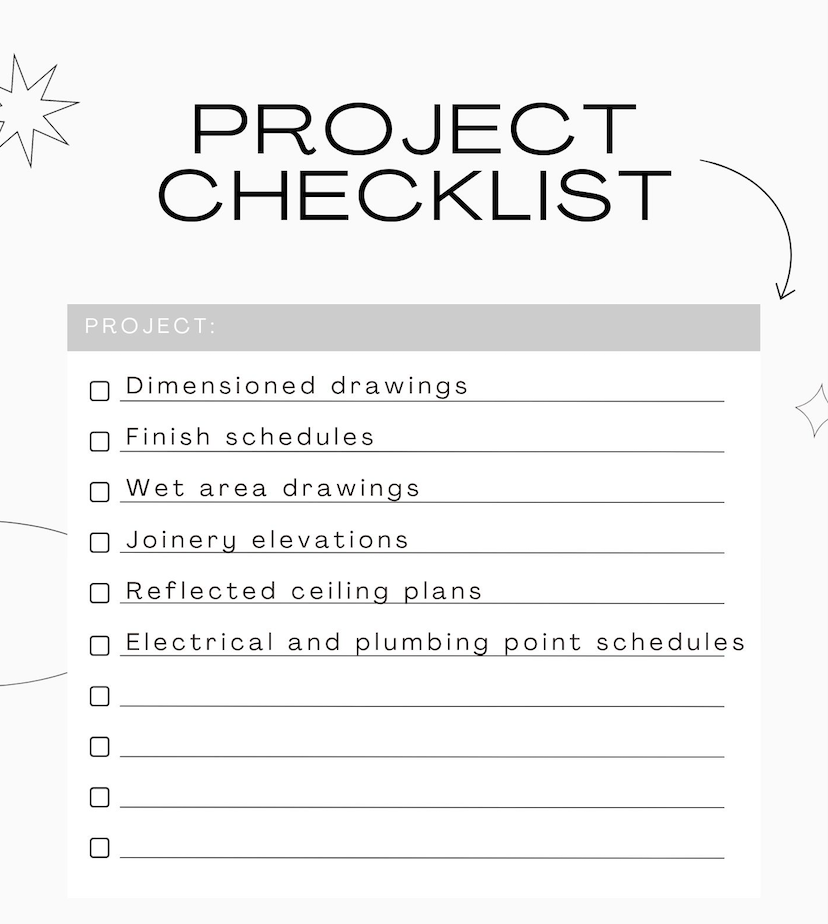
- Dimensioned drawings — not just pretty floor plans, but plans with every measurement a builder needs to set out the work
- Finish schedules — a complete list of every surface material, with product codes, colours, and supplier details
- Wet area drawings — detailed drawings for bathrooms, laundry, and kitchen showing tile layouts, fixture positions, and waterproofing requirements
- Joinery elevations — drawings showing exactly what built-in cabinetry, shelving, and storage should look like
- Reflected ceiling plans — showing the position of every light fitting, fan, exhaust, and ceiling feature
- Electrical and plumbing point schedules — confirming the location of every power point, switch, tap, and drain
When this documentation is complete and clear, a builder can price the job accurately, sequence the trades correctly, and build with confidence. When it's missing or vague, the project slows down — and the client pays for the delay.
HOW WE COMMUNICATE AT EACH STAGE OF A RENOVATION
PRE-CONSTRUCTION: SETTING THE FOUNDATION
Before a builder breaks ground, the designer's job is to ensure that the documentation is complete enough to allow accurate pricing and confident construction planning.
At this stage, communication between designer and builder typically involves:
- A design briefing meeting where the designer walks the builder through the full scope of the project
- A review of the documentation package to identify any gaps or ambiguities
- Confirmation of material lead times and supplier contacts
- Agreement on a communication protocol — how queries will be handled, how decisions will be documented, and who the client's point of contact is
This pre-construction alignment is one of the most valuable things a designer can do. It surfaces problems before they're built in, and it establishes a working relationship between the designer and builder that will carry the project through to completion.
DURING CONSTRUCTION: STAYING IN THE LOOP
Once construction begins, the designer's role shifts from documentation to support. This means:
Regular site visits at key milestones — not to check up on the builder, but to review progress against the design intent and catch any issues before they're covered up or built over.
Responding to RFIs (Requests for Information) promptly. When a builder has a question about a dimension, a material, a detail, they need an answer quickly. A designer who takes days to respond to an RFI creates delays that ripple through the entire construction schedule.
Reviewing shop drawings from cabinetmakers, glaziers, and other specialist trades to ensure they match the design documentation before fabrication begins.
Making on-site decisions when conditions differ from what was planned. In older NSW homes especially, what's behind the walls is often different from what the drawings assumed. A designer who can make clear, confident decisions on-site keeps the project moving.
POST-CONSTRUCTION: THE FINAL REVIEW
Once construction is complete, the designer's communication role shifts again — this time to the client.
A thorough post-construction review involves:
- A final walkthrough with the client and builder to review every element against the design documentation
- A defects list documenting any items that need rectification
- Sign-off on the completed works
- Handover of all product specifications, care guides, and warranty information
This final stage closes the loop on the design process and ensures that the client has everything they need to maintain and enjoy their new space.
THE DOCUMENTATION THAT MAKES BUILDER COMMUNICATION WORK
If there's a single thing that determines the quality of designer-builder communication, it's documentation.
Not the relationship. Not the personality. The documentation.
Because documentation is the medium through which the designer communicates with the builder. It's the thing the builder refers to when they're on-site at 7am and the designer isn't there. It's the thing the tiler uses to set out the bathroom. It's the thing the electrician uses to position the light fittings.
At Findlay & Co., we produce a complete documentation package for every project that includes:
- Design Brief — the agreed scope, vision, and priorities for the project
- Spatial Plans — dimensioned floor plans showing the layout of every room
- Reflected Ceiling Plans — lighting, fan, and exhaust positions
- Wet Area Drawings — detailed drawings for all wet areas
- Joinery Elevations — drawings for all built-in cabinetry and storage
- Finish Schedule — a complete list of every surface material with product codes
- Electrical and Plumbing Point Schedule — confirmed locations for all services
- Selections Board — a visual reference for all materials and finishes
This documentation package is not just a design deliverable. It's a construction tool — the thing that allows the builder to build with confidence and the client to know that what gets built matches what was designed.
WHAT HAPPENS WHEN COMMUNICATION BREAKS DOWN
It's worth being honest about what poor designer-builder communication looks like because it's more common than it should be, and the consequences are real.
Common signs of communication breakdown:
- The builder is making finish decisions because the designer hasn't provided a complete selections schedule
- Trades are arriving on-site without knowing what they're supposed to install
- The client is being asked to make decisions on-site under time pressure
- Variations are accumulating because the original documentation was incomplete
- The designer and builder are in conflict about what was agreed
In a recent survey of Australian homeowners who had undertaken renovations, budget overruns and timeline delays were the two most common complaints and in most cases, they traced back to planning and communication failures rather than construction quality issues
The solution isn't to blame the builder or the designer. It's to establish clear communication protocols from the start, produce complete documentation before construction begins, and maintain an active, responsive relationship throughout the build.
A REAL-WORLD EXAMPLE: NEWCASTLE NEW BUILD
In a recent new build project in Newcastle, our clients were building their forever home — a four-bedroom family home designed around how their family actually lives, with a strong connection to the outdoors and a focus on biophilic design principles.
The project involved a full design documentation package, including detailed wet area drawings for three bathrooms, joinery elevations for a custom kitchen and butler's pantry, and a complete finish schedule covering over 60 individual material selections.
What made the builder relationship work was the pre-construction briefing. We spent two hours walking the builder through the full documentation package before a single sod was turned. Every question was answered. Every ambiguity was resolved. Every material lead time was confirmed.
The result was a construction process that ran with minimal variations and a client who felt informed and confident throughout — not because nothing went wrong, but because when things did go wrong, the documentation gave everyone the information they needed to solve problems quickly and move on.
HOW TO CHOOSE A DESIGNER WHO COMMUNICATES WELL WITH BUILDERS
Not all designers work the same way. If you're planning a renovation in NSW and want to ensure your designer and builder will work well together, here are the questions to ask:
Questions to ask a potential designer:
- What documentation do you produce, and can I see an example?
- How do you handle builder queries during construction?
- How often do you visit the site during the build?
- Have you worked with builders in this region before?
- How do you handle situations where the builder's conditions differ from the design?
- What's your process for managing variations?
A designer who can answer these questions clearly and confidently is a designer who understands that their job doesn't end when the drawings are issued.
FAQ: DESIGNER-BUILDER COMMUNICATION IN NSW
Q: Why is designer-builder communication so important in a renovation?
A: Because the builder builds what the designer documents. If the documentation is incomplete or the communication is poor, the builder has to make decisions that should have been made by the designer — and those decisions are often costly to reverse.
Q: What documentation should my designer provide to my builder?
A: At minimum: dimensioned floor plans, reflected ceiling plans, wet area drawings, joinery elevations, a complete finish schedule, and an electrical and plumbing point schedule. A designer who can't provide this level of documentation is not equipped to support a renovation project.
Q: How often should my designer visit the site during construction?
A: This depends on the complexity of the project, but at key milestones — after demolition, before waterproofing, before tiling, before cabinetry installation, and at practical completion — a site visit from the designer is essential.
Q: What is an RFI and why does it matter?
A: An RFI (Request for Information) is a formal query from the builder to the designer asking for clarification on a design detail. Responding to RFIs promptly is one of the most important things a designer can do during construction. Delayed responses create delays on-site.
Q: Can a designer help if my renovation is already underway?
A: Yes. At Findlay & Co., we offer a Design Decisions Intensive for clients who need focused support at a specific point in their project — whether that's reviewing documentation, making material selections, or resolving a builder query.
Q: Do I need both a designer and an architect for my renovation?
A: For most residential renovations in NSW, an interior designer with strong documentation skills can manage the full design scope. For projects involving structural changes or new builds, you may also need a building designer or architect. We can advise on this during a discovery call. [Link to Discovery Call page]
READY TO WORK WITH A DESIGNER WHO SPEAKS BUILDER?
Findlay & Co works with homeowners across the Hunter Region, Newcastle, and throughout NSW to guide projects from initial concepts through masterful execution. Explore our complete Interior Design Services page to learn about our collaborative process.
If you are planning a renovation or new build and would like expert clarity or validation on your choices before construction begins, we invite you to discover our Design Decisions Intensive. For more information on how we work, please visit our FAQ page.
Ready to discuss your vision? We invite you to book a free discovery call to take the first step.
ABOUT NAOMI FINDLAY
Naomi Findlay is the founder of Findlay & Co., a collaborative interior design studio working with homeowners, renovators, and builders across NSW. With over 15 years of experience in residential design, Naomi brings a rigorous, construction-aware approach to every project — producing documentation that builders trust and clients understand.
Want to know more about our services? Leave your details below