
How We Guide Decision-Making With Clients: The Collaborative Approach to Interior Design

One of the most common fears homeowners have when hiring an interior designer is this: that they'll hand over their home and get back something that looks beautiful but doesn't feel like them. That the designer will make all the decisions, present a finished result, and expect applause. At Findlay & Co., we work completely differently. Decision-making is something we do with our clients — not for them. This article explains how we guide homeowners through the design decision process, why that collaborative approach produces better outcomes, and what it actually looks and feels like to make renovation decisions with a designer by your side rather than waiting for one to hand you the answers.
TABLE OF CONTENTS
- Why Decision-Making Is the Heart of the Design Process
- The Problem With Designer-Led Decisions
- What Collaborative Decision-Making Actually Looks Like
- The Findlay & Co. Decision Framework: How We Guide Without Deciding For You
- The Three Types of Renovation Decisions (And How We Handle Each)
- How We Prevent Decision Fatigue
- A Real-World Example: Hunter Region Family Home
- Why This Approach Produces Better Spaces
- FAQ: Decision-Making in Interior Design
- Ready to Make Decisions With Confidence?
WHY DECISION-MAKING IS THE HEART OF THE DESIGN PROCESS
A renovation is, at its core, a long series of decisions.
Some are enormous like where does the kitchen go, how does the living space connect to the outdoors, what's the structural approach to the extension. Some feel enormous but aren't such as grout colour, tap finish, the exact shade of white for the walls. And some are genuinely small but feel that way too including which direction the floorboards run, whether the pendant lights hang at 2.1 or 2.2 metres.
The quality of those decisions and the confidence with which they're made determines the quality of the finished space.
And here's the thing most people don't realise when they start a renovation: the decisions don't stop. They accumulate. They compound. They arrive at inconvenient times, often under pressure, often without enough information. And if you're making them alone — or worse, having them made for you without your input — the result is a space that might look right but doesn't feel right.
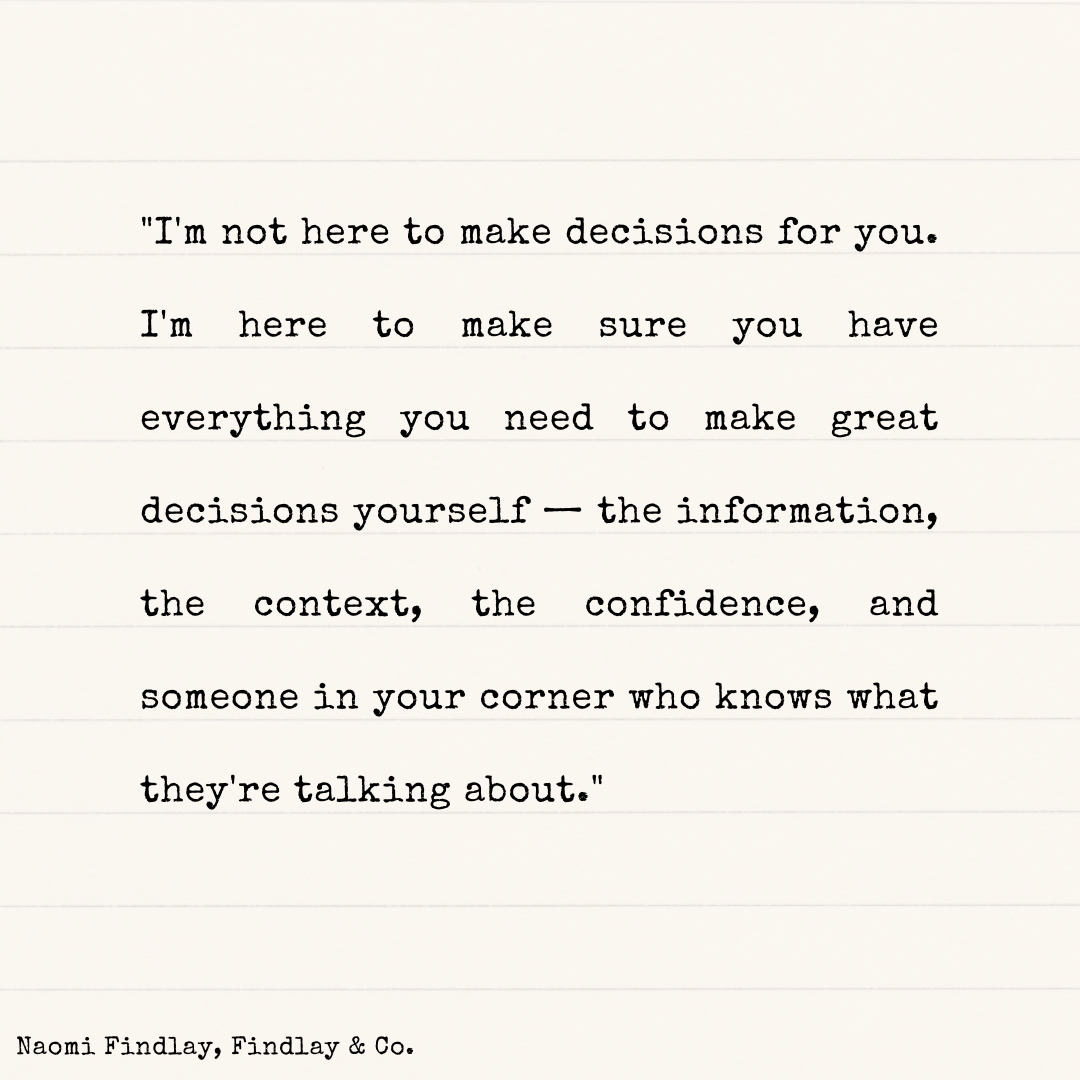
At Findlay & Co., we believe that the homeowner should be at the centre of every significant decision. Not because we don't have opinions — we do, and we share them clearly — but because you're the one who has to live in the space. Your instincts matter. Your life matters. Your family's rhythms and habits and preferences matter.
THE PROBLEM WITH DESIGNER-LED DECISIONS
There's a version of interior design that works like this: the designer disappears for a few weeks, comes back with a fully formed concept, presents it beautifully, and waits for the client to say yes.
It looks impressive. It feels efficient. And it produces spaces that often look stunning in photographs but don't quite work for the people who live in them.
Because the designer made assumptions. About how the family uses the kitchen. About whether the kids do homework at the island or at a desk. About whether the client actually likes the material they said they liked when they saw it on a screen, versus how they feel about it when they hold a sample in their hand in their own home.
Assumptions are the enemy of great residential design.
The alternative isn't to ask the client to make every decision themselves — that's overwhelming and it's not what they're paying for. The alternative is a guided process: one where the designer brings expertise, context, and clear recommendations, and the client brings their lived experience, their instincts, and their honest reactions.
That's the collaborative model. And it produces better spaces.
WHAT COLLABORATIVE DECISION-MAKING ACTUALLY LOOKS LIKE
Collaborative decision-making isn't a philosophy. It's a practice. It shows up in specific, concrete ways throughout the design process.
It looks like this:
- Presenting two or three considered options rather than one "right answer" — with a clear explanation of the trade-offs of each
- Asking questions before presenting solutions: "How do you feel when you walk into this room right now? What's not working?"
- Bringing samples into the client's home rather than asking them to imagine materials in a showroom context
- Explaining the reasoning behind every recommendation so the client understands not just what we're suggesting, but why
- Creating space for the client to say "I don't love that" without feeling like they're being difficult
- Revisiting decisions when new information changes the picture — and being honest when an earlier choice needs to be reconsidered
It doesn't look like this:
- Presenting a finished concept and asking for approval
- Making selections without client input and presenting them as done
- Dismissing a client's instinct because it doesn't align with the designer's aesthetic preference
- Rushing through decisions because the timeline is tight
- Letting the client make uninformed decisions without flagging the implications
THE FINDLAY & CO. DECISION FRAMEWORK: HOW WE GUIDE WITHOUT DECIDING FOR YOU
Over years of working with homeowners through renovations and new builds across NSW, we've developed a clear framework for guiding decision-making. It has four steps.
STEP 1: ESTABLISH THE BRIEF BEFORE ANY DECISIONS ARE MADE
Before we present a single option, we spend time understanding what you actually want not just aesthetically, but functionally and emotionally.
This means asking questions like:
- How do you want to feel when you walk into this room?
- What's not working about the space right now?
- Who uses this space, and how?
- What does "finished" look like to you — not visually, but experientially?
The brief is the anchor for every decision that follows. When we're three months into a project and a decision feels hard, we come back to the brief. It's the north star.
STEP 2: PRESENT OPTIONS WITH CONTEXT, NOT JUST AESTHETICS
When we present material options, layout options, or finish options, we always explain the reasoning behind each one. Not just "this looks beautiful" but:
- This material will age well in a high-traffic area
- This layout creates better flow between the kitchen and the outdoor space
- This finish will show fingerprints in a family with young children — here's an alternative that won't
Context transforms a preference into a decision. And a decision made with full information is one you'll feel confident about for years.
STEP 3: CREATE SPACE FOR HONEST REACTIONS
One of the most important things we do in a client session is make it safe to say "I don't love that."
Many clients feel pressure to agree with their designer — either because they don't want to seem difficult, or because they assume the designer knows best. But a designer who can't hear "that's not quite right" is a designer who will produce a space that's not quite right.
We actively invite honest reactions. We ask: "What's your gut feeling?" We watch body language. We notice when someone says "yes" but their face says "maybe." And we follow up.
STEP 4: DOCUMENT EVERY DECISION CLEARLY
Every decision made in a client session is documented — in writing, with product codes, specifications, and the reasoning behind the choice. This documentation serves two purposes: it gives the client a clear record of what was decided and why, and it gives the builder the information they need to build it correctly.
A decision that isn't documented isn't really a decision. It's a conversation that will have to happen again on-site, under pressure, with less information.

THE THREE TYPES OF RENOVATION DECISIONS (AND HOW WE HANDLE EACH)
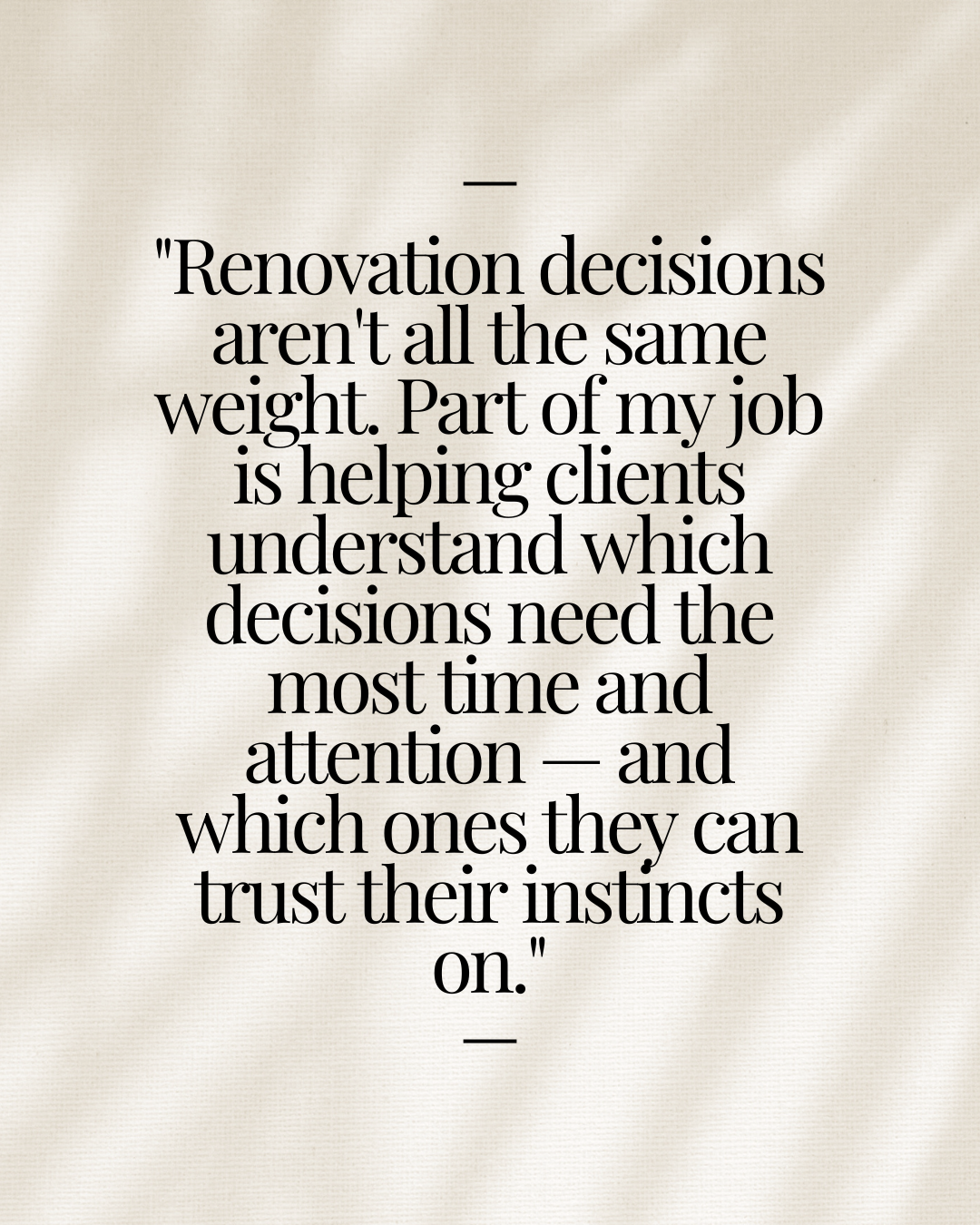
Not all renovation decisions are equal. Understanding the difference helps homeowners know where to invest their energy and where to trust the process.
TYPE 1: STRUCTURAL AND SPATIAL DECISIONS
These are the decisions that are hardest and most expensive to change once made. Where walls go. How rooms connect. The orientation of the kitchen. The position of windows.
How we handle them: These decisions happen early, with the most time and information. We use spatial planning tools, we walk through the space together, and we don't move forward until the client feels genuinely confident — not just willing to proceed.
TYPE 2: MATERIAL AND FINISH DECISIONS
These decisions have a significant impact on how the space looks and feels, and on how it performs over time. Flooring, tiles, cabinetry, tapware, paint colours.
How we handle them: We bring samples into the client's home wherever possible. We present options in context — against the actual light conditions, alongside other confirmed selections. We explain the maintenance and longevity implications of each choice. And we give clients time to sit with decisions before confirming them.
TYPE 3: DECORATIVE AND STYLING DECISIONS
Furniture, lighting, soft furnishings, art, plants. These decisions have the most flexibility and the lowest stakes in terms of reversibility.
How we handle them: We guide rather than prescribe. We present options that align with the brief and the confirmed material palette, and we give clients room to express their own personality within that framework.
HOW WE PREVENT DECISION FATIGUE
Decision fatigue is real. By the third month of a renovation, many homeowners are so exhausted by the volume of decisions they've had to make that they start saying yes to things they're not sure about — just to move forward.
This is one of the most common causes of post-renovation regret.
At Findlay & Co., we actively manage decision fatigue through:
- Sequencing: We present decisions in the right order — structural decisions first, material decisions next, decorative decisions last. We don't ask clients to choose a grout colour before the tile is confirmed.
- Batching: Where possible, we group related decisions into single sessions so clients can see how choices interact with each other, rather than making isolated decisions that may not work together.
- Filtering: We do the research and curation before presenting options. Clients never see every possible tile on the market — they see three or four options that meet the brief, the budget, and the technical requirements. Their job is to choose between good options, not to find the right option in a sea of possibilities.
- Pacing: We build decision milestones into the project timeline so clients know when decisions are coming and have time to prepare. No one should be asked to confirm a major material selection in a five-minute phone call.
A REAL-WORLD EXAMPLE: HUNTER REGION FAMILY HOME
In a recent renovation project in the Hunter Region, our clients — a family of four renovating a 1980s brick home — came to us having already made several decisions they weren't confident about. They'd chosen tiles they weren't sure they loved, confirmed a kitchen layout that didn't feel quite right, and were starting to feel overwhelmed.
We started by going back to the brief. We asked them to describe how they wanted to feel in the finished kitchen. The answer was immediate: "Calm. Functional. Like we can actually cook in it."
The existing layout had the island positioned in a way that created a bottleneck between the cooking zone and the dining area. It looked good on paper but didn't work for how they actually cooked — together, with kids moving in and out of the space.
We presented two alternative layouts with a clear explanation of the trade-offs of each. They chose one immediately — not because we told them to, but because when they saw it in the context of how they actually use the space, it was obvious.
The tiles they'd chosen were reconsidered too. Not because they were wrong aesthetically, but because in the context of the confirmed flooring and cabinetry, they were competing rather than complementing. We presented three alternatives. They chose one in the first session.
The project finished on time. The clients described the process as "the first time a renovation has felt like something happening with us, not to us."
WHY THIS APPROACH PRODUCES BETTER SPACES
Collaborative decision-making produces better spaces for a simple reason: the people who live in a home know things about their own lives that no designer can know from a brief alone.
They know that the morning routine involves three people trying to use the bathroom at the same time. They know that the teenager does homework at the kitchen island, not in their bedroom. They know that the dog comes in from the garden with muddy paws every afternoon and needs somewhere to land before hitting the timber floors.
A designer who makes decisions without this information will produce a space that looks right but doesn't work right. A designer who builds this information into every decision will produce a space that does both.
At Findlay & Co., we believe that the best interior design is the result of two kinds of expertise working together: the designer's knowledge of space, materials, and construction, and the client's knowledge of their own life.
Neither one alone is enough.

FAQ: DECISION-MAKING IN INTERIOR DESIGN
Q: How many decisions will I have to make during a renovation?
A: More than you expect — but fewer than you fear, if you're working with a designer who manages the process well. A full renovation can involve hundreds of individual decisions, but a good designer filters, sequences, and batches those decisions so you're never overwhelmed. You'll make the decisions that matter most; your designer handles the rest.
Q: What if I change my mind after a decision has been confirmed?
A: It depends on the stage of the project. Some decisions can be revisited without consequence; others — particularly structural decisions or items that have already been ordered — may involve costs or delays. We're always honest about the implications of changing a decision, and we work with clients to find the best path forward when minds change.
Q: What if I don't know what I want?
A: That's completely normal — and it's exactly what the design process is for. We don't expect clients to arrive with a clear vision. We help you develop one through questions, examples, and a structured process that surfaces your preferences even when you can't articulate them directly.
Q: How do you handle disagreements between partners or family members?
A: Renovation decisions can surface real differences in taste and priority between partners. We're experienced at facilitating those conversations — helping couples find common ground, understand each other's priorities, and make decisions they both feel good about. We never take sides, and we never let a design preference become a relationship issue.
Q: Can I be involved in every decision, or do I have to trust the designer?
A: You can be as involved as you want to be. Some clients want to be across every detail; others prefer to set the brief and trust the process. We adapt to your preference. What we don't do is make significant decisions without your knowledge or input.
Q: What is a Design Decisions Intensive and is it right for me?
A: Our Design Decisions Intensive is a focused consultation for homeowners who need support with a specific set of decisions — material selections, spatial planning, or a design direction review — without engaging for a full project scope. It's ideal for clients who are mid-renovation and feeling stuck, or who want expert input on a specific decision before committing.
READY TO MAKE DECISIONS WITH CONFIDENCE?
Findlay & Co works with homeowners across the Hunter Region, Newcastle, and throughout NSW to guide projects from initial concepts through masterful execution. Explore our complete Interior Design Services page to learn about our collaborative process.
If you are planning a renovation or new build and would like expert clarity or validation on your choices before construction begins, we invite you to discover our Design Decisions Intensive. For more information on how we work, please visit our FAQ page.
Ready to discuss your vision? We invite you to book a free discovery call to take the first step.
ABOUT NAOMI FINDLAY
Naomi Findlay is the founder of Findlay & Co., a collaborative interior design studio working with homeowners, renovators, and builders across NSW. With over 15 years of experience in residential design, Naomi is known for her ability to guide clients through complex renovation decisions with warmth, clarity, and genuine expertise. She believes that great design happens when the designer and the client are truly working together — not when one is working for the other.
Want to know more about our services? Leave your details below