

What Your Home Sounds Like — And Why It Matters More Than You Think

We spend a lot of time thinking about how our homes look. We think about colour, proportion, texture, light. We curate what we see. We are, as a species, intensely visual — and our approach to interior design reflects that.
What we almost never think about is what our homes sound like.
This is a significant oversight. The acoustic environment of a space — the sounds present in it, the way sound moves through it, the quality of silence it offers — has a measurable effect on human physiology and psychology. And most homes, designed with almost no acoustic intention whatsoever, are considerably noisier and more stressful than they need to be.
THE PHYSIOLOGY OF SOUND
Sound is not a passive experience. It is a physiological one.
The auditory system is one of the most ancient and alert of our senses. Unlike vision, which requires us to direct our attention, hearing is omnidirectional and always on. We cannot close our ears the way we close our eyes. Sound reaches us whether we want it to or not — and the nervous system responds to it whether we're consciously aware of it or not.
Research consistently shows that unwanted sound — noise — activates the stress response. Cortisol rises. Heart rate increases. Cognitive performance declines. The effects are dose-dependent: the louder and more persistent the noise, the stronger the physiological response. But even low-level, chronic noise — the kind that sits just below the threshold of conscious attention — produces measurable stress effects over time.
This matters enormously for how we design homes. A home that is acoustically stressful — that is full of hard surfaces that reflect and amplify sound, that has no acoustic buffering between spaces, that allows external noise to penetrate freely — is a home that is working against the people who live in it, even when they can't name why.
THE DIFFERENCE BETWEEN NOISE AND SOUND
Not all sound is stressful. This is a crucial distinction that biophilic design takes seriously.
The sounds that activate the stress response are, broadly, the sounds of the built environment: traffic, machinery, appliances, electronic devices, the mechanical hum of HVAC systems, the sharp percussive sounds of hard surfaces. These are sounds that our nervous systems have not evolved to find restorative. They are, at a deep biological level, signals of a human-made environment — and our bodies respond to them accordingly.
The sounds that support restoration are, broadly, the sounds of the natural world: water moving, wind in leaves, birdsong, rain on a roof, the crackle of a fire. These are sounds that our nervous systems have evolved alongside. They are, at a deep biological level, signals of a safe, living environment — and our bodies respond to them accordingly.
This is the principle behind what biophilic designers call non-rhythmic sensory stimuli: the unpredictable, nature-based sensory experiences that engage attention gently without demanding it. The sound of water is the most powerful of these. It is consistently rated as restorative across cultures and contexts, and the research on its physiological effects — reduced cortisol, lower heart rate, improved mood — is robust.
WHAT MOST HOMES GET WRONG ACOUSTICALLY
The shift toward hard surfaces in contemporary residential design — polished concrete floors, stone benchtops, large expanses of glass, minimal soft furnishings — has created homes that are acoustically harsh. Hard surfaces reflect sound rather than absorbing it. In a room with hard floors, hard walls, and minimal soft furnishings, sound bounces and amplifies. Conversations become effortful. Background noise accumulates. The acoustic environment becomes a source of low-level stress that most people attribute to something else entirely.
Open-plan living, which has dominated residential design for two decades, compounds this problem. Without walls to contain and absorb sound, noise from one area of the home travels freely through the entire space. The kitchen sounds reach the living area. The television reaches the dining table. The acoustic environment of the whole home is determined by its noisiest activity.
This is not an argument against open-plan living — it has genuine benefits in terms of light, connection, and spatial generosity. It is an argument for designing open-plan spaces with acoustic intention: for including soft furnishings, rugs, curtains, and acoustic panels that absorb sound; for thinking carefully about where noise-generating activities are located; and for creating acoustic refuges — quieter spaces within the home where the nervous system can genuinely rest.
HOW TO ASSESS YOUR HOME'S ACOUSTIC ENVIRONMENT
The most useful exercise is simply to sit quietly in each room of your home and listen. Not to anything in particular — just to what's there.
What do you hear? Traffic? Appliances? The hum of the refrigerator? The sound of the air conditioning? The echo of your own footsteps? The conversation from another room?
Now ask: what don't you hear? Is there any natural sound present — birdsong from outside, the movement of air through an open window, the sound of water? Is there any genuine quiet — not the absence of all sound, but the kind of soft, living quiet that a garden or a forest offers?
Most people, doing this exercise for the first time, are surprised by how much unwanted sound is present in their homes — and how little restorative sound there is.
WHAT GOOD ACOUSTIC DESIGN LOOKS LIKE IN PRACTICE
Acoustic design in residential interiors is not about soundproofing. It's about managing the acoustic environment intentionally — reducing unwanted sound, introducing restorative sound, and creating spaces that feel genuinely quiet.
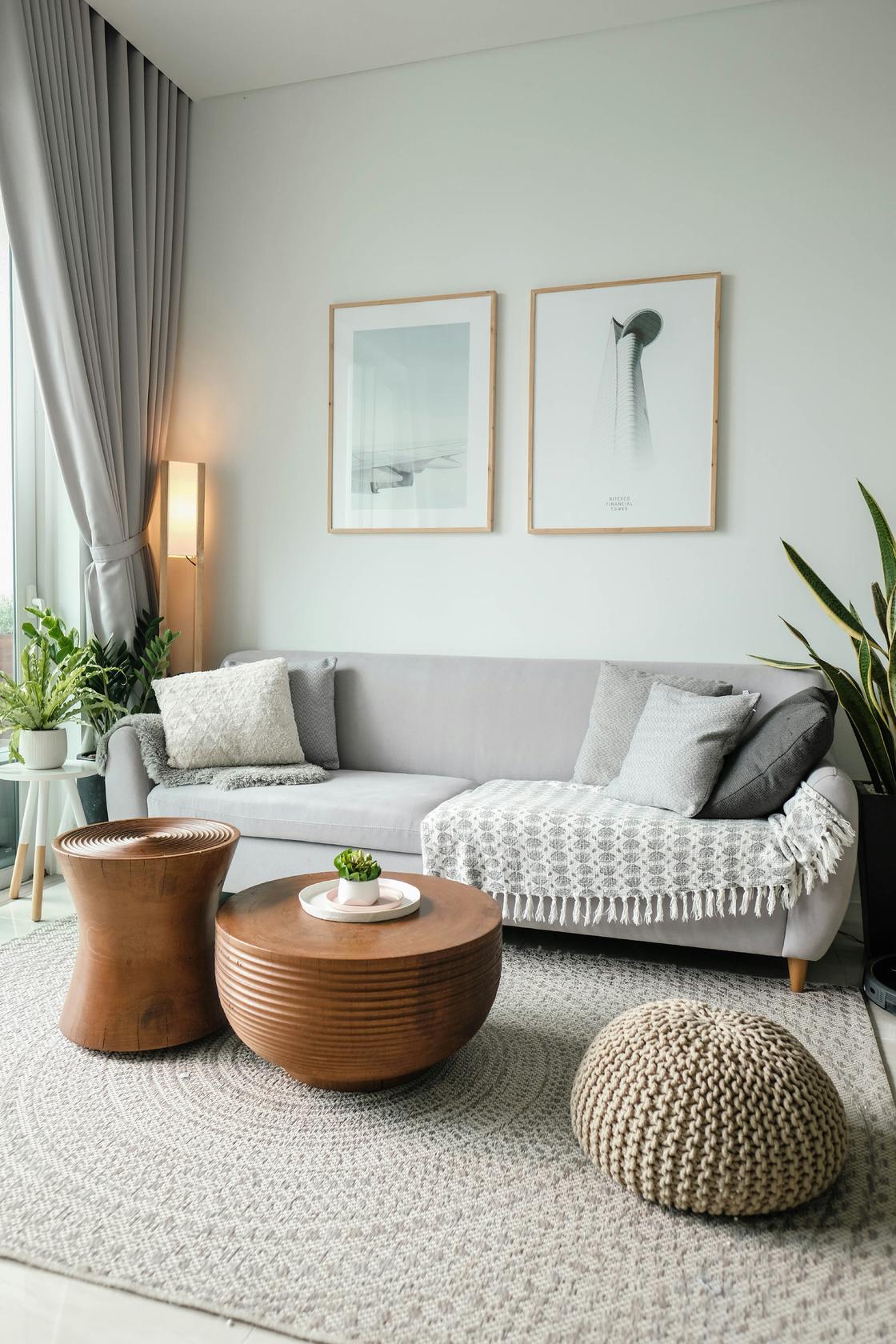
Soft furnishings are the most accessible acoustic intervention available. Rugs, curtains, upholstered furniture, cushions, and throws all absorb sound and reduce reverberation. In a room with hard floors and minimal soft furnishings, adding a large rug can make a perceptible difference to the acoustic quality of the space.
Acoustic panels — fabric-wrapped panels designed to absorb sound — can be integrated into a design in ways that are visually considered rather than institutional. They work particularly well in home offices, media rooms, and open-plan living spaces where reverberation is a problem.
Water features are one of the most effective ways to introduce restorative sound into a home. An indoor water feature — even a small one — introduces the sound of moving water into the acoustic environment. Outdoor water features, positioned near windows or outdoor living areas, bring natural sound into the home without requiring any indoor installation.
Planting — both indoor and outdoor — contributes to the acoustic environment in ways that are often underestimated. Dense planting absorbs and diffuses sound. A well-planted garden reduces the penetration of external noise. Indoor plants, in sufficient quantity, contribute a subtle biological complexity to the acoustic environment — the faint rustle of leaves in moving air, the sense of a living, breathing space.
And sometimes the most powerful acoustic intervention is simply opening a window. The sound of the outside world — when that world includes birds, wind, and the movement of natural things — is one of the most restorative acoustic experiences available. Designing homes that allow natural sound in, rather than sealing it out, is one of the most underrated principles in residential design.
Naomi Findlay is the founder of Findlay & Co., a boutique interior design practice specialising in biophilic wellness design. With a PhD in medical science and over 15 years of experience, Naomi designs spaces for how humans actually feel and live — not just how they look. Findlay & Co. offers in-person design services in the Hunter Region and online consultations Australia-wide.
Curious about the acoustic environment of your home? Book a discovery call with Findlay & Co.
Want to know more about our services? Leave your details below