

Why Where You Sit Matters More Than You Think
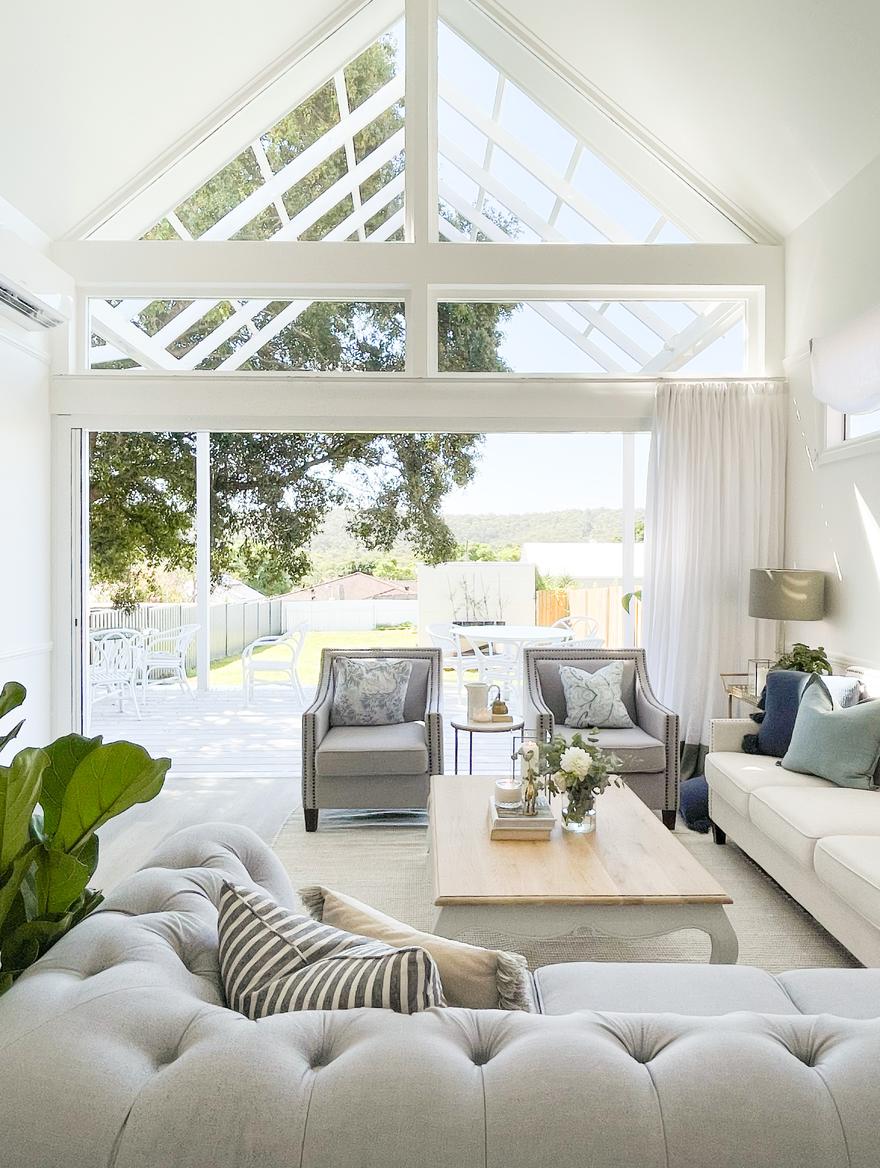
There's a chair in my studio that everyone gravitates toward. It's not the most expensive piece in the room. It's not the most visually striking. But it sits with its back to a solid wall, faces the door, and has a clear view across the whole space. People settle into it differently than they settle into other chairs. Their shoulders drop. They stop scanning the room.
They don't know why. But I do.
What they're responding to is one of the most fundamental principles in biophilic design — and one of the most consistently overlooked in residential interiors. It's called prospect and refuge, and once you understand it, you'll never look at a room the same way again.
WHAT PROSPECT AND REFUGE ACTUALLY MEANS
The theory was developed by geographer Jay Appleton in the 1970s, drawing on evolutionary biology and landscape aesthetics. His central argument was that humans have an innate preference for environments that offer two things simultaneously: prospect (a wide, unobstructed view of the surrounding environment) and refuge (a sheltered, enclosed position from which to observe it).
This preference isn't aesthetic. It's survival-based. Our ancestors needed to be able to see threats approaching while remaining protected from attack. The environments that offered both — a cave mouth overlooking a valley, a tree canopy above an open plain — were the environments where humans felt safest. And that deep neurological preference hasn't gone anywhere. It's still operating in us, every time we walk into a room.
When a space offers good prospect and refuge, the nervous system registers safety. When it doesn't — when we're exposed, with our backs to open space, unable to see who's approaching — the nervous system registers threat. Not dramatically. Not consciously. But persistently, in the background, as a low-level activation that accumulates over time.
HOW THIS PLAYS OUT IN REAL HOMES
The most common prospect and refuge failures I encounter in residential design are surprisingly consistent.
Beds positioned against a wall that faces away from the door. This is one of the most physiologically disruptive arrangements in a bedroom — the sleeper has no visual access to the entry point of the room, which means the nervous system can't fully relax into sleep. The body remains on low-level alert. People often describe this as "not sleeping well" without being able to identify why.
Sofas floating in the middle of a room with no wall behind them. This is a common styling choice — it can look balanced and considered in a photograph. But it creates a persistent sense of exposure for the people sitting on it. There's nothing at their backs. The nervous system reads this as vulnerability.
Dining tables positioned so that some seats face a blank wall at close range. The person sitting there has no prospect — no view, no sense of the wider space. They feel hemmed in, even if the room itself is generous.
Home office desks facing a wall. This is perhaps the most widespread prospect and refuge failure in contemporary homes, accelerated by the shift to remote work. The person working has their back to the room, no view of the entry, and no prospect whatsoever. The result is a persistent low-grade tension that makes sustained concentration harder than it needs to be.
THE NEUROSCIENCE BEHIND THE FEELING
Research in environmental psychology consistently supports what Appleton's theory predicted. Studies using physiological measures — heart rate, cortisol, galvanic skin response — show that people in refuge positions (back supported, view of the space) demonstrate lower stress markers than people in exposed positions, even when the rooms are otherwise identical.
The amygdala — the brain's threat-detection centre — is less activated in environments that offer prospect and refuge. This matters because amygdala activation, even at low levels, draws cognitive resources away from the prefrontal cortex, where we do our clearest thinking, our most creative work, our most connected relating.
In other words: a room that doesn't support prospect and refuge isn't just uncomfortable. It's cognitively and emotionally costly.
WHAT GOOD PROSPECT AND REFUGE LOOKS LIKE IN PRACTICE
The good news is that prospect and refuge is one of the most achievable biophilic principles to address in an existing home. It often doesn't require renovation — it requires rethinking.
In bedrooms, the bed should ideally be positioned so the sleeper has a clear sightline to the door, with a solid wall at the head. This is the single highest-impact change I make in bedroom design, and clients consistently report improved sleep quality as a result.
In living spaces, sofas and armchairs should have something at their backs — a wall, a bookcase, a low partition, a change in ceiling height. The seating should face into the room, with a view of the entry and the wider space. This doesn't mean every seat needs to face the door directly — it means no seat should leave the occupant feeling exposed and unprotected.
In home offices, the desk should face into the room where possible, with the wall at the back. If the room's layout makes this impossible, a mirror positioned to reflect the entry point behind the desk can partially compensate — the nervous system responds to the visual information, even when it's reflected.
In dining spaces, every seat should have some sense of prospect — a view of the room, a window, a sense of the wider space. The seat that faces a blank wall at close range is the seat nobody wants to sit in. That's not a coincidence.
THE RELATIONSHIP BETWEEN PROSPECT, REFUGE, AND CEILING HEIGHT
One element that's often underestimated in prospect and refuge design is ceiling height. Lower ceilings create refuge — they feel enclosed, sheltered, protective. Higher ceilings create prospect — they feel open, expansive, free.
The most successful spaces often play with both. A lower ceiling over a reading nook or a bed creates a sense of shelter. A higher ceiling over a living or dining space creates a sense of openness. The contrast between the two — moving from a lower-ceilinged refuge into a higher-ceilinged prospect space — is one of the most powerful spatial experiences available in residential design.
This is why open-plan living, when it works well, feels so good: it offers genuine prospect. And why a well-designed bedroom, with its lower ceiling and enclosed quality, feels genuinely restful. The two experiences are complementary, and designing for both — within the same home — creates a richness of spatial experience that goes far beyond aesthetics.
A DIFFERENT WAY OF READING A ROOM
Once you understand prospect and refuge, you start reading rooms differently. You notice which seats feel good and which feel exposed. You notice where people naturally gravitate — and where they avoid. You notice the relationship between furniture placement and the entry points of a room, between ceiling height and the quality of enclosure, between the view from a seat and the sense of safety it creates.
These are not small things. They are the difference between a home that feels genuinely good to be in and one that feels subtly, persistently wrong — even when you can't name why.
Naomi Findlay is the founder of Findlay & Co., a boutique interior design practice specialising in biophilic wellness design. With a PhD in medical science and over 15 years of experience, Naomi designs spaces for how humans actually feel and live — not just how they look. Findlay & Co. offers in-person design services in the Hunter Region and online consultations Australia-wide. Want to understand how your home's layout is affecting you? Book a discovery call with Findlay & Co.
Want to know more about our services? Leave your details below