

Water, Air, and the Senses We Forget to Design For
Interior design has a visibility problem.
We design for what we can see. Colour, proportion, texture, light — these are the elements that get the attention, the mood boards, the Pinterest saves. They are the elements that photograph well and translate easily into a brief.
The senses we forget to design for — smell, touch, the feeling of air moving across skin, the sound of water — are the ones that most directly shape how a space feels to be in. And they are almost entirely absent from the way most people think about their homes.
This is a significant gap. Because the research on multisensory design is clear: the spaces that feel genuinely good to inhabit are the ones that engage all the senses, not just vision. And two of the most powerful sensory elements available in residential design — water and air — are the ones most consistently overlooked.
WHAT WATER DOES TO THE NERVOUS SYSTEM
The human relationship with water is ancient and physiological. We evolved near water. Our bodies are mostly water. The sound, sight, and proximity of water triggers responses in the nervous system that are measurable, consistent, and significant.
The research on water and stress reduction is robust. Studies using physiological measures — cortisol, heart rate, blood pressure, galvanic skin response — consistently show that exposure to water environments produces measurable reductions in stress markers. The effect is present for moving water (rivers, fountains, rain) and, to a lesser extent, for still water (ponds, pools). It is present for the sound of water even in the absence of visual contact.
This is why the sound of rain on a roof is almost universally experienced as restorative. Why people seek out water when they need to think or recover. Why coastal and riverside environments command premium prices in the property market. The preference is not cultural or aesthetic. It is biological.
In interior design, water can be introduced in several ways — each with different implications for the sensory environment it creates.
Indoor water features — wall-mounted, freestanding, or integrated into architecture — introduce the sound and sight of moving water into the interior. The effect on the acoustic environment is significant: the sound of water masks unwanted noise, introduces a natural, non-rhythmic sensory stimulus, and creates a sense of aliveness that static interiors lack. Even a small water feature — a tabletop fountain, a wall-mounted trickle — produces measurable effects on the perceived quality of a space.
Outdoor water features, positioned near windows or outdoor living areas, bring the sensory experience of water into the home without requiring indoor installation. A small pond, a water bowl, a simple recirculating fountain in a courtyard — these create an acoustic and visual connection to water that can be experienced from inside the home.
Swimming pools and water gardens, where the site and budget allow, create a more immersive water environment — one that engages not just hearing and sight but touch, temperature, and the full-body experience of immersion.
The principle in each case is the same: water is a biophilic element, and its presence in or near the home creates a sensory environment that is more restorative than one without it.
WHAT AIR QUALITY ACTUALLY MEANS FOR WELLBEING
Air is the most intimate of all the sensory environments. We breathe it continuously, involuntarily, without choice. And the quality of the air in our homes — its freshness, its humidity, its chemical composition, its movement — has a direct and significant effect on how we feel.
The research on indoor air quality and health is extensive. Indoor air is consistently found to be more polluted than outdoor air, even in urban environments. The sources of indoor air pollution are numerous: VOCs off-gassed by synthetic materials, adhesives, paints, and finishes; particulates from cooking, cleaning products, and soft furnishings; biological contaminants from mould, dust mites, and pet dander; carbon dioxide accumulation in poorly ventilated spaces.
The effects of poor indoor air quality are not dramatic in the short term — they are cumulative and chronic. Headaches, fatigue, difficulty concentrating, disrupted sleep, increased susceptibility to respiratory illness. These are the symptoms of a home that is not breathing well. And they are remarkably common.
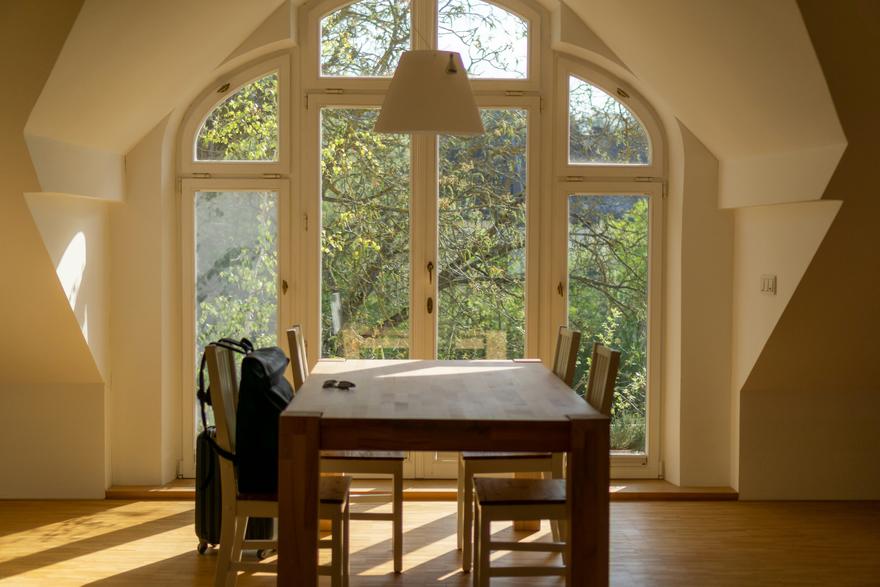
The most powerful intervention for indoor air quality is also the simplest: ventilation. Fresh air moving through a space dilutes pollutants, reduces humidity, and introduces the biological complexity of the outdoor environment — including the microbiome, the phytoncides, and the sensory richness of outside air. A home that can be opened — that has windows positioned to create cross-ventilation, that has outdoor spaces that connect to indoor ones — is a home that breathes.
This is one of the reasons I am consistently sceptical of the fully sealed, climate-controlled home as a design ideal. The ability to open a window and feel outside air move through a space is one of the most powerful biophilic interventions available. It is free, immediate, and physiologically significant.
THE THERMAL DIMENSION OF AIR
Air is not just a chemical environment. It is a thermal one. The temperature and movement of air across the skin is a sensory experience in its own right — one that the nervous system responds to with pleasure or discomfort, with alertness or drowsiness, with a sense of aliveness or stagnation.
The research on thermal comfort and wellbeing is clear: humans are not comfortable at a single fixed temperature. We are comfortable within a range, and we feel most alive when there is some variation within that range — when the air moves, when there is a gentle breeze, when the temperature shifts slightly through the day.
The fully climate-controlled home — sealed, mechanically ventilated, maintained at a constant temperature — eliminates this variation. It is thermally comfortable in a narrow sense, but it is also thermally dead. The nervous system, deprived of the gentle thermal variation that characterises natural environments, registers a kind of sensory flatness that is hard to name but easy to feel.
Designing for thermal variation means designing for natural ventilation: for windows that open, for cross-breezes that move through the space, for outdoor areas that allow the body to experience the full range of the local climate. It means specifying materials — timber, stone, linen — that have varied thermal properties and create a richer tactile environment than synthetic alternatives. And it means being willing to let the home be a little warmer in summer and a little cooler in winter than a fully climate-controlled environment would allow — because that variation is not a failure of comfort. It is a feature of aliveness.
THE OLFACTORY ENVIRONMENT
Smell is the most direct of all the senses — the only one that bypasses the thalamus and connects directly to the limbic system, the brain's emotional and memory centre. This is why scent is so powerfully evocative, so immediately emotional, so difficult to ignore.
The olfactory environment of a home is shaped by everything in it: the materials, the plants, the cooking, the cleaning products, the air quality, the presence or absence of natural ventilation. Most people don't think about it deliberately. But the nose is always working, always sending information to the brain about the quality and character of the environment.
A home that smells of synthetic materials, cleaning products, and stale air is a home that is sending a continuous low-level signal of artificiality to the nervous system. A home that smells of timber, linen, plants, fresh air, and the occasional scent of something cooking is a home that is sending a continuous signal of naturalness, safety, and life.
The most powerful olfactory interventions in residential design are not fragrance products — candles, diffusers, room sprays. These are additions to the olfactory environment, not improvements to it. The most powerful interventions are the ones that address the underlying quality of the air: natural ventilation, natural materials, living plants, and the elimination of synthetic chemical sources where possible.
DESIGNING FOR THE FULL SENSORY EXPERIENCE
The homes that feel genuinely good to be in are the ones that engage all the senses — not just vision. They have a quality of light that shifts through the day. They have natural materials that reward touch. They have an acoustic environment that includes natural sound. They have air that moves and smells of the outside world. And, where possible, they have the presence of water — its sound, its sight, its capacity to restore.
This is what biophilic design is actually about: not a style, not an aesthetic, but a framework for creating spaces that engage the full range of human sensory experience in ways that support wellbeing. It is, at its core, about designing homes that feel alive.
Naomi Findlay is the founder of Findlay & Co., a boutique interior design practice specialising in biophilic wellness design. With a PhD in medical science and over 15 years of experience, Naomi designs spaces for how humans actually feel and live — not just how they look. Findlay & Co. offers in-person design services in the Hunter Region and online consultations Australia-wide.
Want to understand what your home's sensory environment is doing for you? Book a discovery call with Findlay & Co.
Want to know more about our services? Leave your details below